

If you’re stuck in a Florida home with little or no equity and you’re worried about how to sell without losing money, you’re not out of options. With the right approach, including a powerful method called a subject-to mortgage sale, you can avoid paying out of pocket, skip the stress of foreclosure and get a fresh start.
In Florida, it’s become increasingly common for homeowners to owe more on their mortgage than their home is worth. Add in soaring insurance costs, rising interest rates and the reality of unexpected financial hardship, and it’s easy to feel like you’re out of moves.
But you don’t need equity to make a move. Thousands of Florida sellers have already exited tight spots by working with Florida Cash Home Buyers. Our team specializes in creative real estate solutions like subject-to-mortgage sales. Whether you’re facing negative equity, behind on payments or just trying to avoid real estate agent commissions, you’ll find that selling is still possible without draining your savings or damaging your credit.
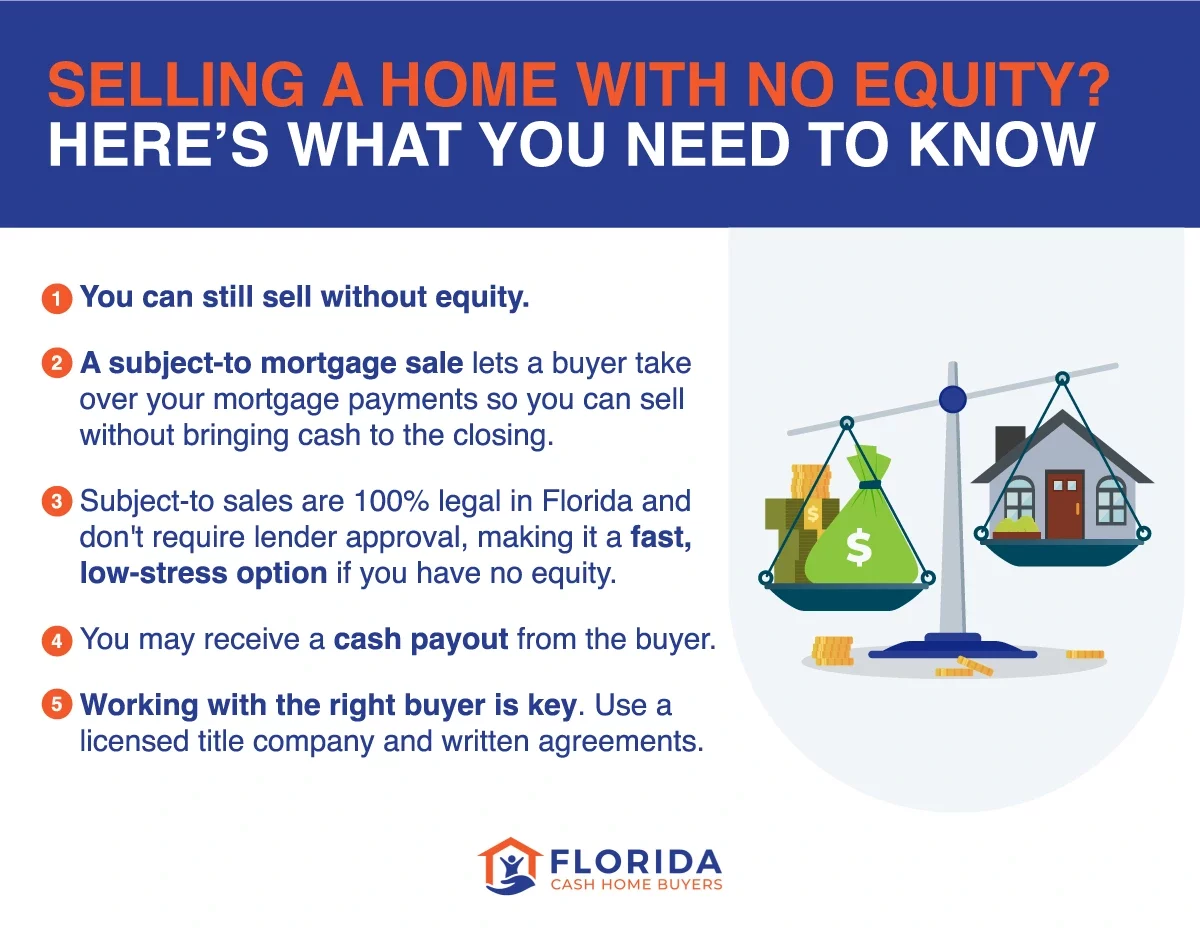
Understanding “No Equity” vs. “Negative Equity”
You have no equity if your home’s value is equal to what you owe on your mortgage. And when your mortgage balance is higher than what your home could sell for, you’re in negative equity, also known as being underwater.
When selling costs like commissions and closing fees push you even further underwater, listing on the market isn’t just stressful — it’s often not a viable option because you have to bring cash to close. That’s why many homeowners turn to creative sale methods, like subject-to mortgages, that bypass traditional roadblocks altogether.
The Solutions That Work When You’re Stuck Without Equity
When you don’t have equity, your options get narrow, but they’re not zero. Depending on your financial situation, timeline and how far underwater you are, here are the four realistic ways to sell a home with no equity in Florida.
|
Your No-Equity Selling Options at a Glance
|
|||||
|---|---|---|---|---|---|
| Option | Speed | Out-of-Pocket Cost | Credit Impact | Viable If You’re Behind on Payments? | Need Lender Approval? |
| Subject-to Mortgage | Fast | None | Minimal to none | ✅ Yes | ❌ No |
| Short Sale | Slow | Usually none | Moderate to severe | ✅ Yes | ✅ Yes |
| Deed in Lieu | Slow | Usually none | Severe | ✅ Yes | ✅ Yes |
| Bring Cash to Closing | Fast | High | None | ❌ No | ❌ No |
Option 1: Sell Using a Subject-to Mortgage
Best fit for most Florida sellers with no or negative equity
A subject-to mortgage sale allows a buyer — like Florida Cash Home Buyers — to take over your existing mortgage payments, without needing to refinance or pay off the mortgage loan. The mortgage stays in your name, but the buyer takes the title to the home and assumes responsibility for making payments moving forward.
This is one of the fastest, most flexible solutions for Florida homeowners who need to sell with zero equity, especially when they can’t afford to bring cash to closing. In some cases, the buyer may also pay you a lump sum at closing, even if you’re underwater. This extra cash can help you cover moving costs, secure a rental or simply give you some breathing room during a tough financial time.
When It Works:
- You have no equity or are underwater.
- You need to sell quickly, without waiting on lenders.
- You can’t afford repairs, agent commissions or closing costs.
- You’re behind on payments or at risk of falling behind.
- You’re relocating or downsizing to reduce financial stress.
Pros:
- No lender approval required
- No agent fees, commissions or closing costs
- No repairs, home improvements or staging required
- Fast closings, often within days to a few weeks
- Helps protect your credit from further damage
- Zero out-of-pocket expenses to sell
- Keeps foreclosure off your record
Cons:
- The loan stays in your name and appears on your credit report.
- It can affect your debt-to-income ratio, making it harder to qualify for a new mortgage.
- Missed payments by the buyer can still impact your credit.
- The lender may call the loan due if they find out that the property was sold. Both the buyer and seller need to be aware of this.
What to Consider:
- The loan remains in your name, so it’s essential to work with a reputable, transparent investor who will consistently make on-time payments because missed or late payments impact your credit.
- Not every buyer understands how subject-to works, which makes it even more important to choose someone experienced and professional.
Most investors dabble in subject-to deals. Florida Cash Home Buyers specializes in them. We’ve helped hundreds of Florida homeowners walk away from high-stress properties with a cash offer and without paying a dime, all while using licensed title companies, written payment tracking and a fully transparent process. With us, you get a legal home sale with peace of mind, not pressure.
Option 2: Short Sale
Best for deep negative equity with lender cooperation
A short sale is when your lender agrees to let you sell the home for less than your mortgage balance. It’s only possible if you can prove financial hardship (like job loss, divorce or medical issues), and you must submit full documentation and wait for the bank’s decision.
The process begins by listing the home at market value. Once you receive an offer, it’s submitted to your lender along with your hardship letter, financials and supporting documents. The lender reviews the package and decides whether to approve the sale.
When It Works:
- You’re significantly underwater.
- You’re unable to keep paying the mortgage.
- You can prove a qualified hardship.
- You have time to wait for lender approval (usually 90 to 180 days).
Pros:
- Avoids foreclosure
- May release you from the debt balance
- Often better for your credit than foreclosure
Cons:
- Lender approval required
- Long wait times
- Significant credit score impact
- Bank may deny the sale or pursue the balance if not forgiven
Option 3: Deed in Lieu of Foreclosure
Last resort for severely distressed sellers
A deed in lieu of foreclosure means you voluntarily transfer ownership of your home back to the lender instead of going through foreclosure. It’s usually only offered after missed payments and failed alternatives like loan modification or short sale.
If the lender agrees, you’ll sign legal documents transferring the deed, and in return, the lender releases you from the mortgage and may waive the deficiency judgement. You’ll usually need to vacate the home quickly, and the lender may require proof that you’ve made a genuine effort to sell the property first. The entire process must be approved by the lender and handled through formal paperwork, often with attorney support.
When It Works:
- You’ve already defaulted on your mortgage.
- You don’t qualify for a short sale.
- The lender agrees to release you from further obligations.
Pros:
- Stops the foreclosure process
- May reduce additional legal fees or court costs
- Slightly less credit damage than foreclosure
Cons:
- Serious credit impact (can drop your score 100 to 150 points)
- Lender must approve and may still pursue deficiency
- Walk away with nothing and no control over timing
Option 4: Bring Cash to Closing
Only works for small equity gaps
You can always choose to sell at a loss and cover the difference between the sale price and your mortgage payoff with your own funds. But for most sellers facing financial hardship, this is the least practical option.
When It Works:
- You’re only short by a few thousand dollars.
- You have savings or assistance to cover the deficit.
- You want to fully resolve the mortgage and move on.
Pros:
- Clean break from the property
- No ongoing obligations
- No negative impact on credit
Cons:
- Requires upfront cash
- Often unrealistic for distressed sellers
- Doesn’t fix the real problem: lack of equity
The Hard Truth About Selling with No Equity
Trying to sell a home with no equity or negative equity means you’re fighting the math from day one. The sale price likely won’t cover your remaining mortgage, and that’s just the start.
Here’s what makes a no-equity sale so difficult in Florida:
- Closing costs alone can run 2% to 5% of the sale price.
- Realtor commissions eat up another 5% to 6%.
- Buyers expect repairs, concessions or seller credits.
- You may have to pay out of pocket to close or risk foreclosure.
- Holding on means paying for two homes if you need to move.
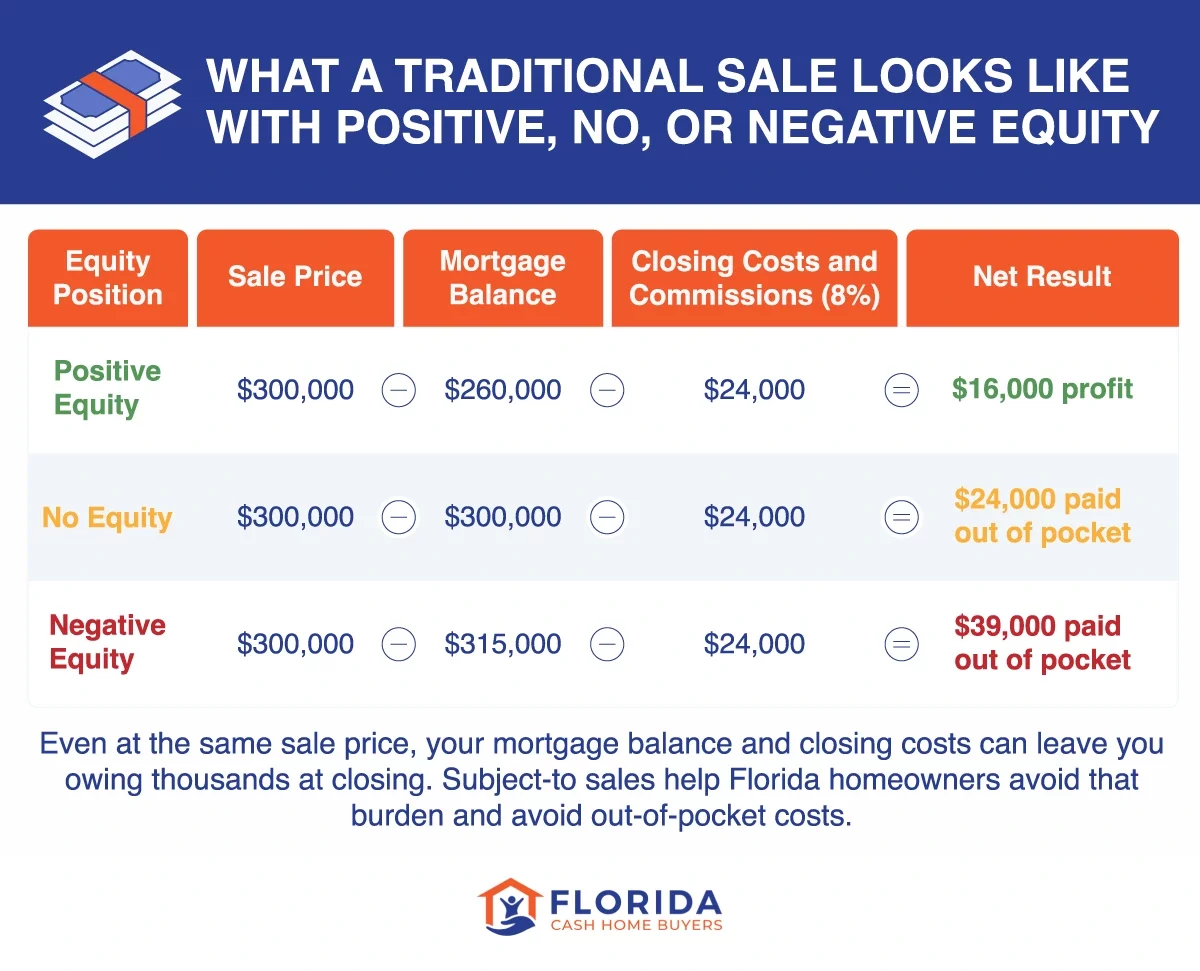
And if you’re already behind on mortgage payments, that pressure builds fast. Most sellers in this position don’t have the cash or the time to wait months for a buyer. That’s why many Florida homeowners turn to creative strategies that avoid commissions, eliminate out-of-pocket costs and offer fast relief from their mortgage.
Assessing Your Financial Situation
Before deciding how to sell, it helps to know exactly where you stand. Your break-even point tells you whether a traditional sale would leave you with equity, a deficit or right at zero.
How to Calculate Your Break-Even Point
Gather these numbers:
- Mortgage payoff amount (from your lender)
- Any second mortgages, HELOCs or liens
- Estimated closing costs (usually 2% to 5% of sale price)
- Realtor commission (typically 5% to 6%, if listing on MLS)
| Sample Break-Even Calculation | |
|---|---|
| Item | Amount |
| Estimated Sale Price | $275,000 |
| Mortgage Payoff Balance | – $268,000 |
| Estimated Closing Costs | – $22,000 |
| Estimated Shortfall | – $15,000 |
In this example, the seller would need to bring $15,000 to closing.
Once you know your break-even point, evaluate your personal financial capacity:
- Available savings: Do you have savings that could cover the deficit? Be realistic about how much you’re willing or able to deplete.
- Other assets: Do you have other assets you could liquidate, like investments or another property?
- Family assistance: Is there a possibility of financial support from family members?
- Income stability: If you consider bringing cash to closing, is your income stable enough to manage that financial strain?
- Credit score: Your credit score will influence your ability to secure a personal loan if that becomes an option to cover closing costs.
This honest assessment will help you understand whether conventional selling is even feasible or if alternative strategies are necessary.
You should start exploring alternatives like a subject-to mortgage or short sale if:
- Your equity deficit is more than $5,000 to $10,000.
- You can’t afford necessary repairs to sell on the market.
- You’re struggling with double payments (mortgage + rent elsewhere).
- You’ve been denied a refinance or loan modification.
If any of these apply, selling the traditional way likely won’t work, and trying to wait it out could hurt your credit or lead to foreclosure.
Red Flags When Exploring No-Equity Solutions
When you’re in a vulnerable position, the wrong investor can make things worse. If someone’s offering to “take over your mortgage” or help you sell with no equity, be cautious. Here’s what to watch out for:
- They avoid using a licensed Florida title company. Legitimate subject-to and cash sales should always go through a proper closing with legal documentation and title transfer.
- No written plan or payment tracking. You should always receive a written agreement detailing how your mortgage will be handled, how taxes and insurance will be paid and how you’ll be protected long term.
- They push for fast signatures without clear answers. Pressure tactics or vague explanations are signs the investor may not have your best interests at heart.
- They make unrealistic promises. Be wary of phrases like “instant approval,” “guaranteed loan relief” or “we’ll fix your credit.” These are often marketing hooks, not guarantees.
- No transparency about what happens to your loan. A trustworthy buyer will walk you through the subject-to process, including how they’ll manage payments, keep insurance in place and protect your credit.
When in doubt, ask for proof of past transactions, demand everything in writing and make sure a licensed title company is involved. Florida Cash Home Buyers has built its reputation on doing things the right way: legal contracts, title company closings and clear communication every step of the way.
You Don’t Need Equity to Sell
If you’re a Florida homeowner with no equity, negative equity or a home you simply can’t afford anymore, you’re not stuck. You don’t have to default. You don’t have to wreck your credit. And you definitely don’t have to bring thousands of dollars to the closing table. Florida Cash Home Buyers specializes in helping sellers in exactly your situation.
Whether your mortgage is upside down, you’re behind on payments or you just need to move fast, we offer:
- Subject-to mortgage solutions, so you can sell without equity, lenders or delays
- Fast closings (often in 15 to 30 days)
- Zero repairs, agent fees or staging needed
- Licensed title company closings for your protection
- Peace of mind, knowing you’re not going through it alone
We’ve helped hundreds of Florida homeowners walk away from tough mortgages without stress, without judgment and without spending a dime out of pocket. Let’s see if we can help you too. Fill out our quick form for a free, no-pressure consultation.