
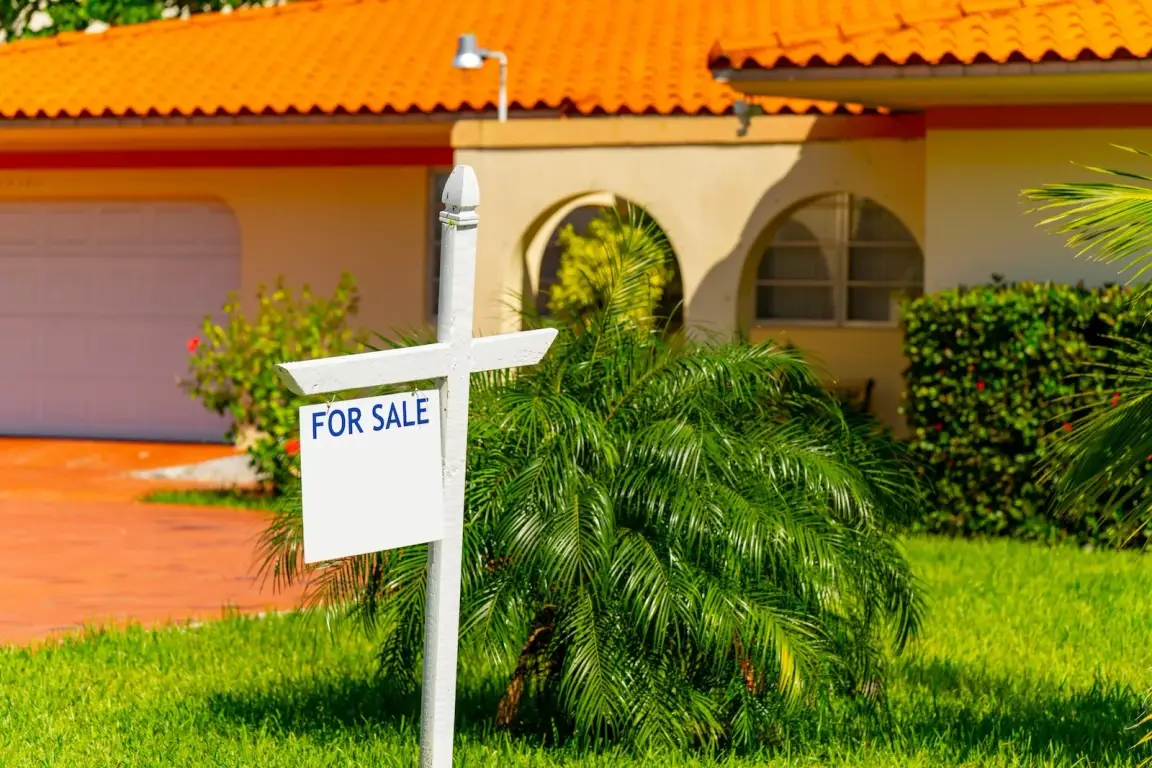
In most cases, it’s not just one issue holding a home back, it’s how multiple factors work together to shape buyer perception. For example, weak listing photos can hurt your home’s first impression, which lowers perceived value and makes your asking price feel too high, even if it’s aligned with comps. Pricing, presentation, the home’s condition and market conditions all influence each other, and small issues can quickly compound.
In Florida, there can be additional challenges tied to the housing market, including rising insurance costs, HOA fees, and affordability concerns. Understanding what’s holding your home back is the first step toward fixing it or deciding if a different selling strategy makes more sense.
If your home has been sitting on the market with little to no interest, you’re not alone. Many homeowners list their property expecting a quick home sale, only to face weeks or even months without serious buyers. It can be frustrating, especially when you’re working with a real estate agent or listing agent and still not seeing results.
If you’re feeling stuck or unsure what to do next, you’re not out of options. Florida Cash Home Buyers works with homeowners across Florida to help them sell quickly without the stress of traditional home selling.
Quick Diagnosis: Why Your House Isn’t Selling
If your home isn’t selling, the pattern of buyer activity (or lack of it) can reveal what’s going wrong. Use the quick guide below to identify the most likely issue before diving deeper into each cause.
| What You’re Experiencing | What It Usually Means | What’s Likely Happening |
|---|---|---|
| Very few showings | Your listing price may be too high, or your presentation isn’t showing enough value for that price. | Price + perceived value mismatch → Buyers skip your listing entirely. |
| Lots of showings, but no offers | Buyers may see issues with your home value, condition or overall first impression. | Strong interest, weak conversion → The home doesn’t justify the asking price in person. |
| Offers that fall through | Financing, home inspection, appraisal or insurance issues may be getting in the way. | Deal friction → Problems arise after buyers try to move forward. |
| Sitting on the market 60+ days | Your home may be overpriced, or current market conditions are reducing demand. | Stale listing effect → Buyers assume something is wrong and hesitate. |
| Little to no online interest | Weak listing photos, lack of professional photography or limited marketing efforts aren’t drawing in buyers. | Low visibility or weak first impression → Buyers never click or engage. |
Each of these scenarios points to a different issue, but in many cases, it’s a combination of factors that’s preventing your home from attracting serious buyers and moving toward a successful home sale.
14 Reasons Why Your Home May Not Be Selling
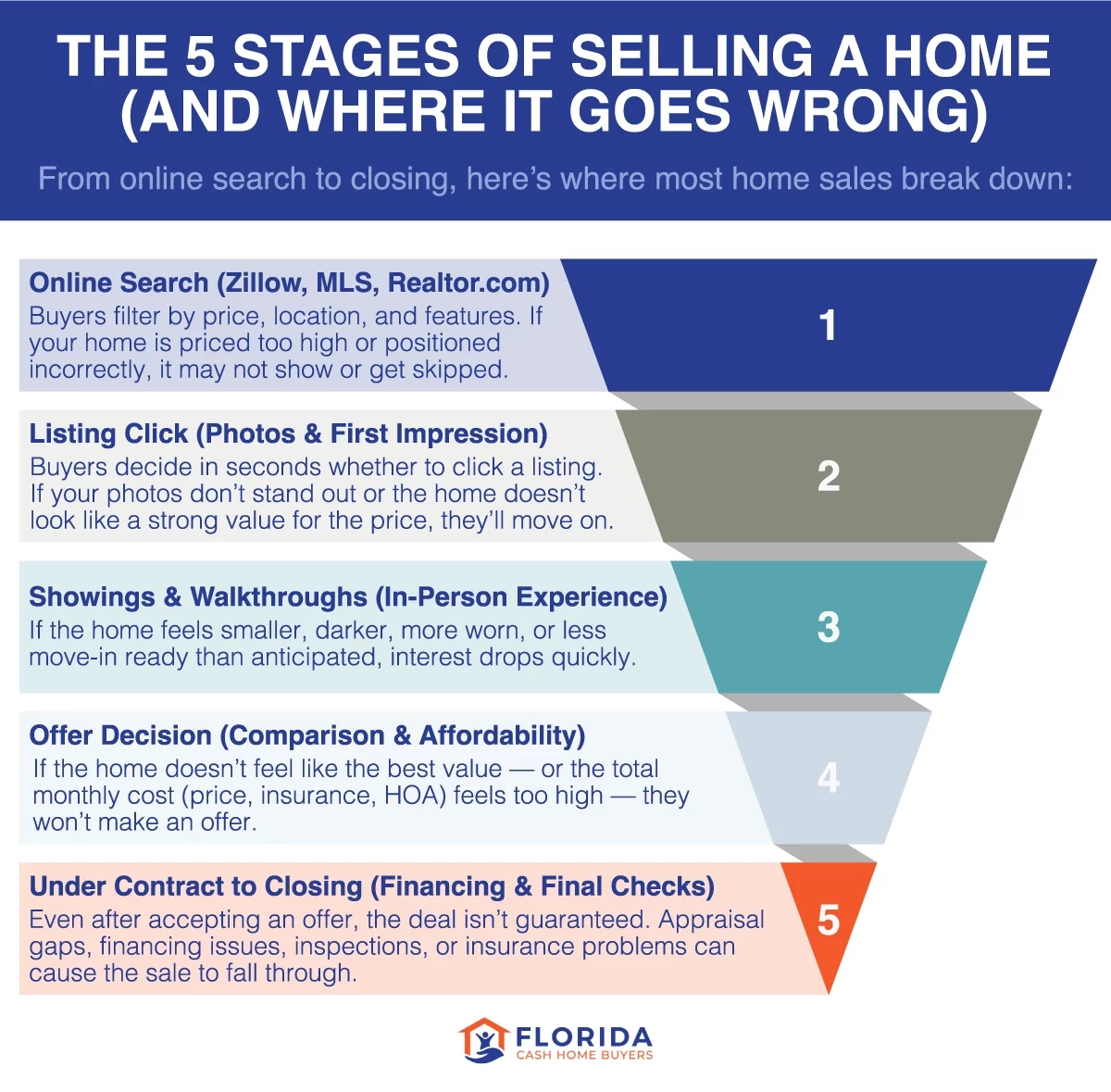
If your house isn’t selling, it’s usually not just one issue — it’s a combination of factors that affect how potential buyers perceive your home. From pricing and condition to marketing strategy and market conditions, even small missteps can impact your ability to attract serious buyers and close a successful home sale. Below are the most common reasons homes don’t sell, and what you can do about them.
1. Buyers Don’t See Enough Value for the Price
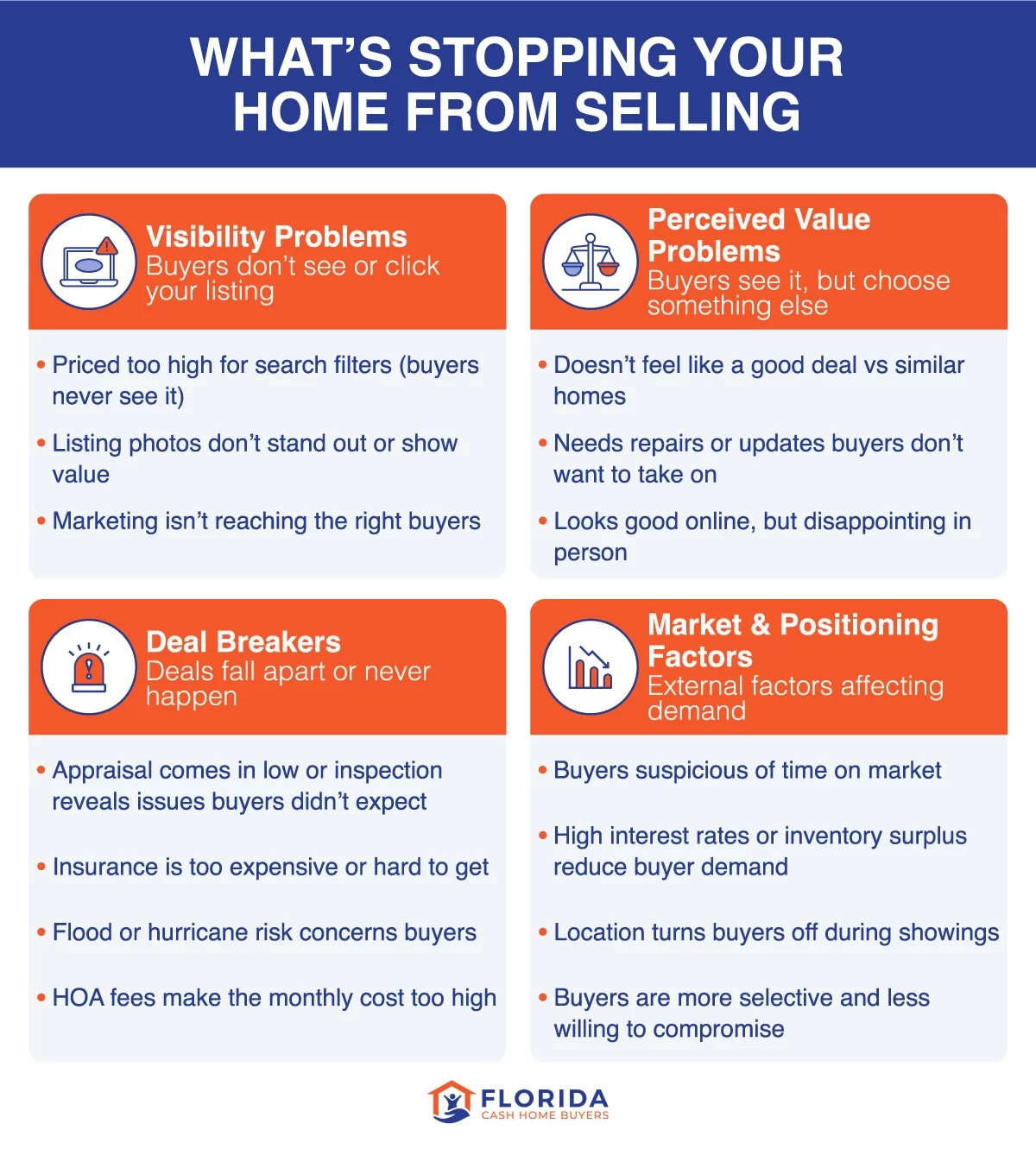
Even if your home is priced in line with market value, buyers may still pass if it doesn’t feel like the best option. At this stage, your home is getting seen, but it’s losing in comparison to similar homes. Today’s buyers are constantly weighing trade-offs: price vs. condition, upgrades vs. location and monthly cost vs. long-term value. In Florida, that comparison often includes insurance costs, HOA fees and overall affordability, which can make competing properties feel like a better deal.
Why it matters: Home buying is a relative decision. If another property feels more move-in ready, better updated or more cost-efficient at a similar price point, buyers will choose that home, even if yours is objectively “fairly priced.”
What to do:
- Compare your home like a buyer would. Look at similar homes side-by-side and ask which one feels like the better deal (and why).
- Identify where you’re losing on value perception. Condition, upgrades, layout or total monthly cost can all tip the scale.
- Close the gap strategically. This could mean small upgrades, stronger presentation or adjusting price to better reflect how buyers are comparing options.
- Be realistic about trade-offs. If your home lacks certain features, pricing and positioning need to compensate for that.
2. The Home Is Priced Too High
Overpricing is one of the most common reasons a home doesn’t sell. If your listing price is out of line with similar homes and recent sales, buyers may never even see your property or click into it. In Florida, this is amplified by rising insurance costs, HOA fees and affordability pressures. Buyers are filtering aggressively based on total monthly cost, so pricing even slightly above expectations can push your home out of their search range.
Why it matters: If your home is priced too high relative to comps, it becomes invisible or easily skipped during the search process — before buyers ever evaluate its features or condition.
What to do:
- Sanity-check your price against active search ranges. Look at how buyers are filtering (not just comps).
- Price for visibility, not negotiation. “Testing the market” often reduces early momentum.
- Account for total cost of ownership. Insurance, HOA fees, and taxes affect where buyers are willing to look.
- Make a decisive adjustment if needed. Early corrections are far more effective than reacting after weeks of inactivity.
3. The Listing Photos and Marketing Aren’t Strong Enough
If your home doesn’t stand out visually, it may never get a real opportunity, regardless of price. Most buyers begin their search online, and your listing photos determine whether they click or keep scrolling. Photos don’t just showcase your home, they shape how buyers perceive its value. If the images are dark, cluttered or underwhelming, even a well-priced home can feel less desirable than competing listings. In Florida, where many buyers are relocating or browsing remotely, strong visuals are even more critical.
Why it matters: Buyers make split-second decisions while scrolling. Low-quality photos can make your home feel like a worse value — or not worth exploring at all — leading to fewer clicks, fewer showings and less overall interest.
What to do:
- Evaluate your listing like a buyer. Scroll through similar homes and see how yours compares at a glance.
- Make sure your presentation supports your price. If your photos don’t reflect the value you’re asking, buyers will assume it’s overpriced.
- Upgrade your visuals strategically. Professional photography, better lighting and decluttering can significantly improve perceived value.
- Think beyond photos if needed. If interest is low, your overall marketing approach — not just exposure — may need to better highlight your home’s strengths.
4. The Home Needs Repairs or Renovations
Homes that require repairs or major renovations often struggle to attract buyers, especially when many are looking for move-in ready properties. But it’s not just about the actual work involved, it’s how buyers perceive that work. Even relatively minor issues can signal “more problems beneath the surface,” making the home feel like a bigger project than it really is. In Florida, this is amplified by insurance and inspection concerns, where items like roof condition, water damage or older systems can directly impact insurability and financing.
Why it matters: Buyers tend to overestimate the cost, time, and risk of repairs. As that perceived effort increases, your buyer pool shrinks, often leaving only investors or highly price-sensitive buyers willing to move forward.
What to do:
- Identify what buyers will flag immediately. Roof age, water damage, outdated systems, visible wear or other major issues can trigger concern during a walkthrough or home inspection.
- Decide whether to fix or price accordingly. If you’re not making repairs, your pricing needs to reflect the perceived effort, not just the actual cost.
- Reduce uncertainty where possible. A home warranty, inspection report or repair estimates can help buyers feel more confident.
- Be strategic about first impressions. Addressing a few visible issues up front can prevent buyers from assuming the entire home is high maintenance.
5. The Home Doesn’t Show Well in Person
Even if your listing performs well online, the in-person experience is what ultimately determines whether a buyer makes an offer. At this stage, buyers are no longer comparing photos, they’re reacting to how the home feels during a walkthrough. A home that looked appealing online can quickly lose momentum if it feels smaller, darker or more worn than expected. That gap between expectation and reality is often what causes buyers to walk away.
Why it matters: Home buying is an emotional decision. If buyers can’t easily picture themselves living in the space — or if something feels “off” when they walk through — it becomes much harder to justify the price, even if everything looked good online.
What to do:
- Focus on alignment between online and in-person. Your home should feel as good (or better) than it looks in photos.
- Identify what buyers notice immediately. Landscaping, lighting, layout flow, odors and clutter all shape first impressions within seconds.
- Remove friction from the experience. Decluttering, depersonalizing the decor and improving lighting can make the home feel more open and move-in ready.
- Pay attention to how the home lives, not just how it looks. Small adjustments to layout or staging can help buyers better understand the space.
6. The Home Has Been on the Market Too Long
When a home sits on the market for too long, it can create a ripple effect that makes it even harder to sell. At this stage, the issue isn’t just time, it’s how buyers interpret that time. In a competitive real estate market, newer listings tend to attract the most attention. As your home lingers, it shifts from a “new opportunity” to something buyers question. In Florida, where inventory and demand can fluctuate seasonally, timing can further impact how quickly that perception changes.
Why it matters: The longer your home sits, the more buyers assume there’s a hidden issue — whether it’s pricing, condition or something they’re not seeing. That perception reduces urgency, increases skepticism and often leads to fewer serious buyers and lower offers.
What to do:
- Focus on resetting momentum, not making small tweaks. Minor price reductions or updates often go unnoticed — larger, strategic changes are more effective.
- Reposition the listing. This could mean new photos, updated marketing or a clearer value proposition based on current comps.
- Make a decisive price adjustment if needed. Waiting too long can lead to larger price reductions later.
- Align with current market conditions. If demand has shifted, your pricing and expectations may need to shift with it.
7. Market Conditions Have Shifted
Even if your home was priced correctly when it was first listed, changes in the real estate market can quickly impact demand and the eventual sale price. What worked a few months ago may no longer align with how buyers are evaluating homes today. In Florida, this can shift quickly due to seasonal demand, insurance costs and changing affordability. As interest rates rise or inventory increases, buyers become more selective, and the pool of active buyers shrinks.
Why it matters: Buyer behavior is highly sensitive to affordability. Small changes in interest rates, insurance costs or home prices can significantly impact purchasing power, which means fewer buyers are searching — and those who are tend to be more cautious and value-focused.
What to do:
- Reprice based on today’s market, not when you listed. Past comps may no longer reflect current buyer behavior.
- Watch how similar homes are performing now. Focus on active listings and recent price adjustments, not just closed sales.
- Adjust expectations as demand shifts. Longer timelines and more negotiation may be part of the current market.
- Position your home competitively within current conditions. Buyers have more options, so standing out matters more than ever.
8. Insurance Costs and Availability
In Florida, insurance is no longer a background detail — it’s often a deciding factor in whether a home sells. Buyers aren’t just evaluating your asking price, they’re factoring in insurance costs as part of the total monthly payment. For some properties, especially older homes or those in higher risk areas, insurance isn’t just expensive, it can be difficult to secure at all. That uncertainty alone can cause buyers to walk away.
Why it matters: Insurance can directly impact both affordability and financing. If coverage is too expensive — or unavailable — buyers may not qualify for a loan, or they may choose a different property with lower risk and more predictable costs.
What to do:
- Reduce uncertainty up front. Provide insurance estimates or recent quotes so buyers understand the full cost of ownership.
- Highlight risk-reducing features. Newer roofs, impact windows and storm protection can improve insurability and buyer confidence.
- Be prepared for deeper questions. Buyers may ask about claims history, roof age or prior damage — having clear answers builds trust.
- Factor insurance into your pricing strategy. If costs are higher than comparable homes, that may need to be reflected in how the home is positioned.
9. Hurricane Risk or Flood History
Florida buyers are increasingly aware of environmental risks, especially in coastal or flood-prone areas. Even if your home is in good condition today, buyers are often thinking ahead and evaluating what could happen in the future. Properties with past hurricane damage or located in higher risk zones can face more scrutiny, not just for what’s visible but for what buyers assume might happen over time.
Why it matters: Risk perception plays a major role in buyer decision-making. Concerns about future storm damage, flooding or ongoing maintenance can make a home feel less secure — even if it’s been fully repaired — leading buyers to hesitate or choose lower-risk alternatives.
What to do:
- Be transparent and proactive. Clearly disclose any past damage and how it was addressed.
- Provide proof of improvements. Documentation of repairs, renovations or mitigation efforts helps build trust.
- Highlight risk-reducing features. Elevation, drainage, reinforced structures or storm protections can shift perception.
- Help buyers feel confident in the future, not just the present. The more uncertainty you remove, the easier it is for buyers to move forward.
10. High HOA Fees or Condo Costs
In many Florida communities, HOA fees and condo assessments play a major role in how buyers evaluate affordability. Even if your listing price is competitive, the total monthly cost can make your home feel more expensive than it appears at first glance. Buyers aren’t just comparing home prices, they’re comparing monthly payments. When HOA fees, insurance and taxes are factored in, your property may fall into a higher affordability bracket than similar homes without those added costs.
Why it matters: A home can be priced correctly and still lose out if the all-in monthly cost feels too high. Buyers often filter based on what they can comfortably afford each month, so higher fees can reduce your buyer pool or push buyers toward competing properties.
What to do:
- Be up front about total monthly costs. Transparency around HOA fees and assessments helps set expectations early.
- Frame what buyers are getting. If fees cover maintenance, amenities, or insurance, make that value clear.
- Compare on a monthly basis, not just price. Look at how your home stacks up against similar homes when total costs are considered.
- Adjust pricing or positioning if needed. If your home sits in a higher cost bracket, the value needs to be clear, or the price needs to reflect it.
11. The Location Has Hidden Drawbacks
Even in desirable areas, certain location-specific factors can impact buyer interest, especially once they experience the home in person. These are often things that don’t fully come through in listing photos but become obvious during a walkthrough. Whether it’s traffic noise, limited parking, proximity to commercial areas or differences in school zones, these details can influence how buyers feel about the home, even if everything else checks out.
Why it matters: Location is one of the few factors you can’t change. If something about the setting doesn’t align with a buyer’s preferences, it can quickly become a deal-breaker, regardless of price or condition.
What to do:
- Acknowledge the trade-offs. Buyers will notice these factors, so pricing and positioning need to reflect them.
- Lead with what offsets the drawback. Layout, upgrades, condition or price can help rebalance the equation.
- Set expectations early. Clear descriptions can help attract buyers who are less likely to be turned off in person.
- Price competitively within your micro-location. Compare your home to others with similar location characteristics, not just the broader area.
12. Financing or Appraisal Issues Are Killing Deals
Sometimes a home does attract buyers, but the deal falls apart before closing. In Florida, this is increasingly common, not because buyers lose interest, but because lenders or insurance companies won’t approve the property. Common issues that inhibit approval include roof age, 4-point inspection concerns, non-warrantable communities and appraisals coming in below contract price.
Why it matters: Many financed deals depend on both loan approval and insurability. If either fails, the entire transaction can collapse. Failed deals put your home back on the market, making it appear less desirable and extending the time it takes to sell. Buyers may start to wonder what went wrong, which can impact future offers and negotiating leverage.
What to do:
- Make sure your price can pass an appraisal. If your home is priced above what lenders will support, deals are more likely to fall apart, even if buyers are willing.
- Identify red flags and lender and insurance requirements early. Issues that come up during a home inspection (roof, systems, condition) can delay or derail financing.
- Understand buyer strength, not just offer price. Financing type, down payment and lender reliability all impact whether a deal will close.
- Be prepared to navigate gaps and negotiations. Appraisal shortfalls or lender conditions are common — having a plan can keep deals together.
13. The Listing Isn’t Reaching the Right Buyers
Even a well-priced, well-presented home won’t sell if the right buyers never see it. At this stage, the issue isn’t necessarily your home, it’s how your listing is being positioned and distributed. If your listing isn’t reaching buyers actively searching in your price range, location or property type, it can quietly underperform without any obvious red flags.
Why it matters: Visibility drives opportunity. If your listing isn’t consistently getting in front of qualified, serious buyers, you’ll see fewer showings and fewer chances to generate offers, regardless of value or condition.
What to do:
- Evaluate who your listing is actually reaching. Consider whether you’re attracting the right buyers for your price point and property type.
- Strengthen how your home is positioned. Clear, benefit-driven descriptions help the right buyers recognize it as a fit.
- Expand beyond baseline exposure. Simply being on the MLS isn’t always enough in a competitive market; consider leveraging social media and other platforms.
- Make sure your marketing aligns with your ideal buyer. The more targeted the exposure, the more likely you are to attract serious interest.
14. Buyer Expectations Have Changed
The way people approach home buying has shifted, and in many cases, expectations are higher than they were just a few years ago. Homes that might have sold quickly before may now require stronger presentation, sharper pricing or clearer value to compete. Today’s buyers are more informed, more selective and more sensitive to total cost. In Florida, that often includes insurance, HOA fees and long-term affordability, not just the purchase price.
Why it matters: Buyers are comparing more, expecting more and compromising less. If your home doesn’t feel move-in ready, competitively priced or aligned with current expectations, it’s easier for buyers to move on to other options.
What to do:
- Reevaluate your home against today’s standard, not past results. What sold quickly before may not reflect current buyer expectations.
- Focus on perceived ease and livability. Clean, well-presented and move-in ready homes attract more serious buyers.
- Be realistic about where your home fits. Condition, features and total cost all influence how buyers compare your property.
- Adjust your strategy to match the current market. Pricing, presentation and positioning all need to align with today’s buyer behavior.
In most cases, a home doesn’t sell because of a combination of factors — not just one. Slight overpricing, average listing photos and minor condition issues can quickly add up, making your home less appealing to potential buyers. The key is identifying which of these issues is affecting your home and taking the right steps to correct it before your listing sits on the market too long.
For some homeowners, adjusting the listing price, making repairs or waiting for the right buyer simply isn’t realistic. Whether you’re dealing with time constraints, financial pressure or a property that needs significant work, the traditional home selling process doesn’t always fit your situation. In these cases, exploring alternative selling options — such as working with a cash home buyer — can provide a more predictable and streamlined path forward.
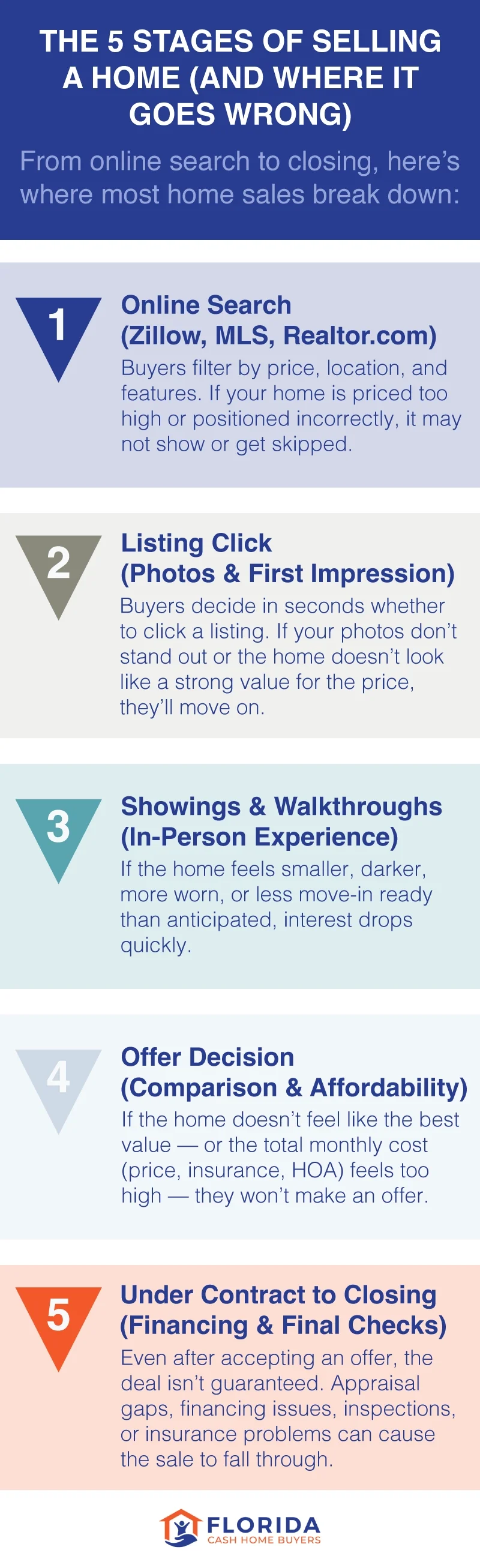
How Long a House Should Take to Sell (and When to Take Action)
Every home sale timeline is different, but how long your property sits on the market can directly impact how buyers perceive its value. In most cases, the longer a home stays listed without serious interest, the more likely buyers are to assume something is wrong, even if that’s not the case. If you want a deeper breakdown of typical timelines, you can also read our guide on how long it takes to sell a house in Florida.
| Time on Market | What It Signals |
|---|---|
| 0–30 days | Normal in most markets |
| 30–60 days | Early signs of pricing or demand issues |
| 60–90 days | Buyer hesitation increases |
| 90+ days | Major changes are likely needed to attract serious buyers |
Signs it’s time to re-evaluate your strategy:
- Your home has been on the market for 60 to 90+ days without serious offers.
- You’ve had multiple showings, but no prospective buyers are moving forward.
- You’re hearing the same feedback repeatedly (price, condition, layout).
- Similar homes in your area are selling faster.
Taking action early — whether through a price adjustment, improved marketing efforts or repositioning your listing — can help prevent your home from becoming stale. And if your home has been sitting longer than expected, exploring alternative options like selling directly to a cash buyer may offer a faster, more predictable path forward.
Sell Your Florida House Quickly, Without the Stress
If your home isn’t selling, there’s always a reason. Sometimes it’s something that can be adjusted, but when the challenges involve financing, insurance, condition or legal complications, the traditional process doesn’t always work.
That’s when working with a direct cash buyer can help.
With Florida Cash Home Buyers, you can:
- Sell your home as-is — no repairs or renovations required.
- Skip open houses, showings, and repeated walkthroughs.
- Avoid financing delays and uncertain buyers.
- Choose a closing timeline that works for you.
We work with homeowners across Florida in situations where traditional sales fall through. If your home has been sitting on the market or you’re dealing with a situation that makes selling difficult, you don’t have to keep waiting and hoping for the right buyer. Florida Cash Home Buyers is here to help. We offer a straightforward way to sell your home and take the next step with confidence.